Changing the Game, for Good
Light doesn't lag. And that changes everything.

A few days ago, I was listening to NPR. The segment was measured, sober — the way NPR usually is. The subject was the gaming industry, and the question being asked was whether competitive gaming has a sustainable financial future. Studios are shutting down. Games with hundred-million-dollar production budgets are failing at launch. Esports leagues that raised institutional capital are folding or consolidating. The analysts interviewed offered careful explanations: the market is oversaturated, attention spans are contracting, player retention is harder than ever, competition is brutal.
I kept listening, and I kept thinking: that diagnosis is not wrong. It is just incomplete.
The gaming industry is not failing because games have stopped being compelling. It is struggling because the business models the industry runs on were designed around infrastructure constraints — constraints so old, so embedded in the economics of the business, that most people inside the industry have stopped noticing they are there. The $70 price tag. The server-dependent multiplayer architecture. The loot box and battle pass mechanics. The aggressive in-game monetization that players resent but studios depend on. None of these were designed because they were good for players. They were designed because they were the only models the underlying technology could support.
The studios failing today are not failing because gaming is dying. They are failing because they are running 2025 businesses on 1995 infrastructure logic.
And here is the thing about infrastructure constraints: when they are removed, everything built around them has to be rebuilt from scratch. That is not a threat to gaming. It is the breakout the industry has been waiting for — whether it knows it yet or not.
I. Speed Is the Game
Every assumption baked into the gaming industry — local hardware, upgrade cycles, the console in your living room, the GPU you replaced last year, the server farm in Virginia — traces back to a single engineering constraint: computation takes time, and networks are slow.
Silicon switches in the tens of thousands of femtoseconds. That is the speed of the chips inside every gaming device on earth today. The physics of the electron, moving through doped silicon, sets a ceiling that no amount of engineering ambition has been able to raise for decades. Chipmakers make the transistors smaller. They stack them in three dimensions. They optimize the architecture. But the ceiling stays where it is.
In photonic computing, light replaces the electron. A validated photonic switch — independently tested at a leading technical research institute — has demonstrated switching speeds of 150 to 200 femtoseconds. The prior record in published literature was 600 femtoseconds. Silicon’s best is not in the same conversation. The gap, when measured against the full architecture of a computing system, translates to something on the order of 10,000 times faster, with roughly 90 percent less energy consumed and no cooling water required.
A femtosecond is one quadrillionth of a second — a unit so small that light, the fastest thing in the universe, travels less than the width of a human hair in that time. The switch that makes photonic computing possible operates at that scale.
I want to be precise about what that means for gaming, because the implications are not obvious at first.
When compute happens at those speeds with near-zero overhead, the device in your hand stops being the machine. The network becomes the machine. The display — your phone, your television, a pair of lightweight glasses, a wall-sized screen at a sports arena — becomes a window. The render happens elsewhere, in a photonic compute fabric, and arrives at your eyes at speeds below the threshold of human perception.
The form factor question — glasses, goggles, stadium screen, phone — becomes aesthetic, not technical. If the network is fast enough, any surface that receives light is a gaming platform.
This is why I believe the current debates about cloud gaming have been asking the wrong question. The industry has been asking whether cloud gaming can be made good enough. The real question is whether the network can be made fast enough. Google Stadia failed because the network was not fast enough. Xbox Cloud Gaming is limited because the network is not fast enough. The promise of any screen becoming a gaming device has existed for twenty years. The infrastructure to fulfill it has not — until the physics finally caught up.
When latency drops below the threshold of perception, the hardware upgrade cycle ends. Not slows — ends. The player never buys another graphics card. The compute fabric upgrades continuously, and every player, on every device, always has access to the best hardware available. Because the hardware is no longer in their home.
II. The Trust Problem Gaming Never Solved
Gaming — every form of it, from casino floors to mobile to competitive esports — operates on a trust deficit that the industry has never been able to close. Players do not know if outcomes are truly fair. Regulators cannot verify that operators are honest. Competitive players suspect, sometimes correctly, that matchmaking systems are designed to optimize engagement rather than fairness.
The industry has spent decades and enormous resources building compliance architectures, third-party auditing systems, and certification frameworks — all of which are, at their core, sophisticated attempts to create the appearance of fairness, because true cryptographic verifiability was computationally impossible at the speeds required for real-time gaming.
The phrase “provably fair” exists in gaming. It describes systems that use cryptographic methods to allow players to verify outcomes after the fact. These systems are real and meaningful. But they operate at the edges of the industry, mostly in cryptocurrency-adjacent gaming, and they carry a computational overhead that makes them impractical for mainstream, real-time applications at scale.
Photonic hash computation changes that calculus entirely.
A Hash Engine built on photonic switching performs cryptographic hash functions in the optical domain at femtosecond speeds. What this means in plain terms: every outcome — every dice roll, every card dealt, every match result, every in-game event — can be cryptographically signed and independently verified in real time, with no perceptible delay, at no meaningful additional cost. Not “trust the random number generator.” Not “our auditor certified the system.” Check the math yourself. Instantly.
Provably fair outcomes are not just an ethical upgrade. They are a regulatory moat — and a new market category.
I believe this becomes a mandatory standard within a decade. Gaming jurisdictions worldwide are under pressure from players, legislators, and advocacy groups to require verifiable outcomes. The infrastructure that delivers true verifiability at scale — not simulated verifiability, not audited verifiability, but mathematical verifiability built into the compute layer — will define which platforms are trusted and which are merely tolerated.
The implications extend beyond traditional gaming. Competitive esports, skill-based wagering, fantasy sports, prediction markets — every category where outcome integrity is commercially critical benefits from the same architecture. The trust problem gaming never solved becomes, with photonic hashing, not a problem at all. It becomes a structural advantage for the platforms built on the right foundation.
III. The Transaction Gaming Never Had
The gaming industry has already figured out where the real money is. It took a few decades, but the lesson has been learned clearly: the door price is almost beside the point.
Fortnite never charged an upfront fee and generated over five billion dollars in 2022 through in-game purchases. GTA Online generates over one billion dollars annually from transactions that happen inside a game that launched more than a decade ago. Free-to-play titles — games that cost nothing to acquire — now generate the majority of global gaming revenue. The $70 AAA launch price is, increasingly, the old business. The business inside the game is the new one.
But here is what the winning model cannot yet do: make the transactions small enough to match the moment.
Processing a transaction under one dollar on existing silicon infrastructure costs more in overhead than many of those transactions are worth. The payment rails — credit card networks, digital wallets, platform fee structures — were built for a world where transactions had meaningful dollar values. A $0.003 tip. A $0.0001 per-second billing increment. A fraction-of-a-cent royalty earned every time a creator’s in-game asset is used. These transactions exist conceptually. They do not exist economically. The infrastructure makes them irrational to execute.
Photonic micro-payment rails dissolve that constraint.
When the compute overhead of processing a transaction drops to near zero, the minimum viable transaction size follows. Entirely new economic grammars become possible. Play-per-minute billing that charges only for the time actually played, at a rate that makes a two-minute session make financial sense for both the player and the developer. Peer-to-peer tipping that fires the instant a streamer lands a spectacular play, from thousands of simultaneous viewers, with each tip smaller than a cent but meaningful in aggregate. In-game skill economies where a brilliant competitive move earns micro-royalties from spectators in real time.
The reason these models do not exist today is not a lack of imagination. It is a payment infrastructure that makes transactions below a certain size economically irrational. Remove the floor, and the entire landscape of gaming economics changes.
Consider what this means for creators. Streamers and content creators currently earn through platform revenue shares, subscriptions, and sponsorships — all structured around the limitations of existing payment infrastructure. A direct micro-royalty model, where viewers compensate creators at the moment of value rather than through subscription abstraction, has never been economically viable. It is arriving.
Consider what it means for developers. The current in-game transaction model is, in many forms, adversarial — players resent paywalls, loot boxes, and pay-to-win mechanics precisely because these models were designed to extract maximum revenue from a payment floor that required large transactions. When the floor disappears, the adversarial dynamic can be replaced with something more honest: tiny, frequent, voluntary transactions that align perfectly with the moment of value.
The big winners in gaming already know the money is inside. What they do not yet have is the infrastructure to make the transactions as small as the moments deserve. That infrastructure is arriving.
IV. The City as the Console
I want to describe something that does not yet have a commonly accepted name, because I think naming it matters.
A downtown photonic mesh network is not a faster version of the internet. It is a different kind of infrastructure entirely. A fabric of photonic compute nodes, connected at sub-millisecond latency, distributed across a city — inside buildings, at street-level infrastructure points, in venues, in transit hubs — creates something that has not existed before: a compute environment where every connected endpoint, regardless of its physical form, draws from the same processing capability with effectively zero perceptible lag.
Now consider what that means for the endpoints.
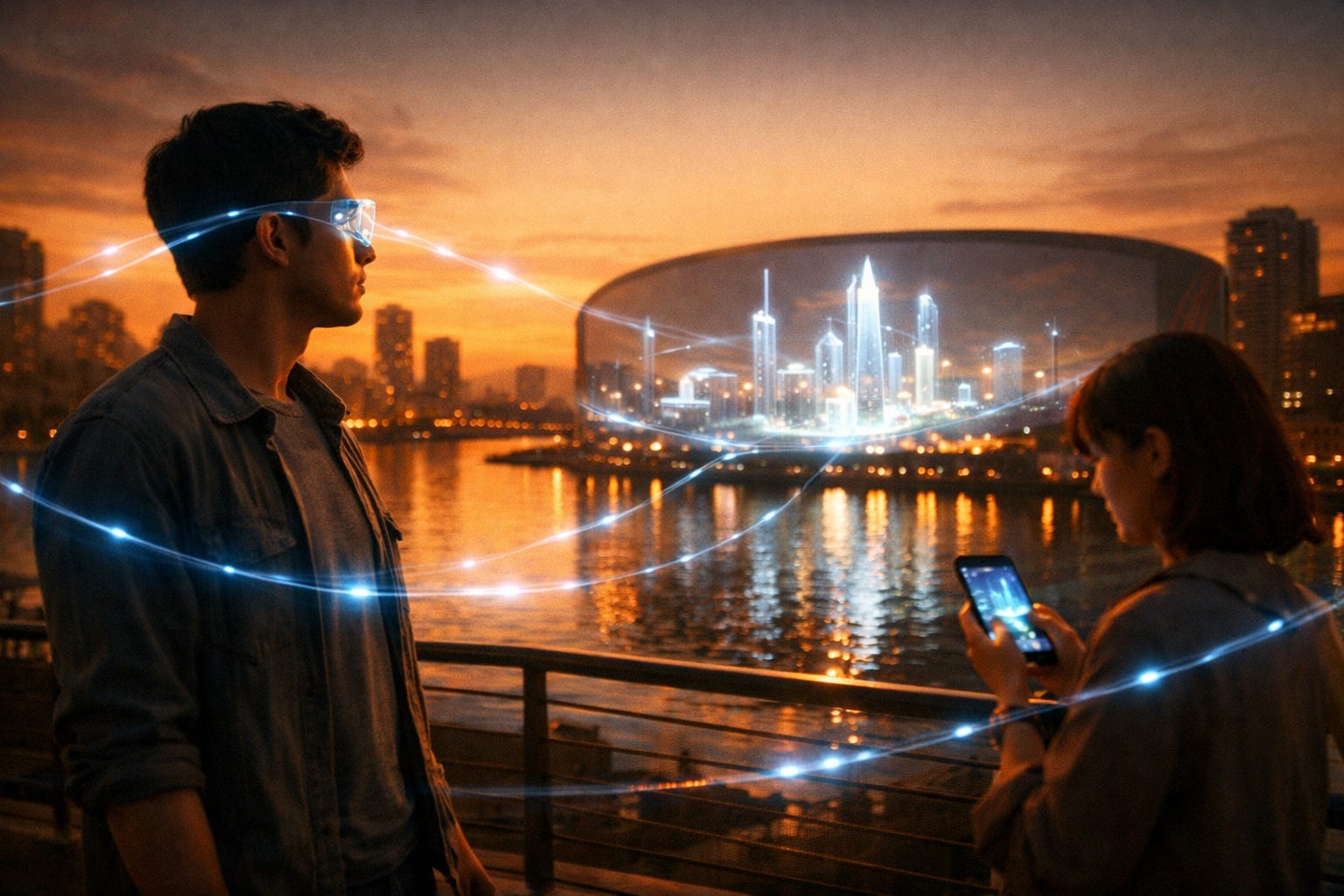
A pair of lightweight glasses on a street corner. A stadium screen displaying synchronized content to forty thousand people simultaneously. A hotel room television. A bar wall. A phone in someone’s pocket. On a photonic mesh, these are not different classes of device with different capability profiles. They are different windows into the same compute fabric.
Picture two people — one wearing glasses standing outside a stadium, one watching a screen inside it — occupying the same game world, at the same latency, with the same rendering fidelity. No headset required. No console required. No GPU in a backpack. The form factor is aesthetic. The experience is identical. The network is the machine.
Before a photonic mesh scales to a city, it has to prove itself somewhere. The environment I have in mind is a fifteen-acre waterfront site in New Orleans — a contained, controlled space where every node, every surface, every transaction can be tested at human scale without the regulatory and infrastructure complexity of a municipal deployment. A place where the glasses, the stadium screen, the bar wall, and the peer-to-peer micro-payment all operate together in a single live environment, in front of real people, before the architecture is handed to a city. A proving ground. The city comes after. But the city has to start somewhere.
This is not the metaverse. The metaverse was a rendering problem wrapped in a marketing campaign. This is an infrastructure problem that has been solved at the physics level.
The metaverse promised that virtual and physical environments would blend. What it could not deliver was the network to make that blend imperceptible. The human vestibular system detects motion-to-photon delays above twenty milliseconds and registers them as discomfort — which is why VR headsets at current network speeds cause simulator sickness in many users, and why prolonged use of current AR glasses remains a niche experience rather than a mainstream one. The problem was never the display technology. It was always the latency.
When that latency disappears, the blending of digital and physical environments stops being a product category and starts being an ambient fact of urban life. Multiplayer is no longer server-mediated and lag-compensated. It is immediate. Stadium gaming events are not about watching a screen — they are about thousands of participants sharing a single compute environment with individual interfaces. The arena becomes a platform. The city becomes a platform.
I think the implications for how games are designed — not just how they are distributed or monetized, but what they fundamentally are — have not yet been seriously contemplated by the people who build them. That gap between available infrastructure and the games designed to use it is not unusual. It is, historically, how every major platform shift in gaming has begun.
What Changes, and What Doesn’t
Every major transition in gaming history was enabled by an infrastructure change that arrived before the games that used it. The arcade-to-console shift. The console-to-internet shift. The internet-to-mobile shift. In each case, the infrastructure changed first. The business models changed second. The games — the ones that fully exploited what the new infrastructure made possible — arrived last.
The NPR story that prompted this essay is asking a real question about a real problem. Hundreds of studios have closed. Hundreds more are under financial stress. The $70 model is under pressure from all sides — from player resistance, from rising development costs, from the free-to-play alternatives that have already claimed the majority of industry revenue. The diagnosis of an industry in difficulty is accurate.
What the diagnosis misses is the timing.
The infrastructure that breaks every broken model in gaming simultaneously — that removes the latency constraint shaping hardware economics, the computational ceiling limiting fairness architecture, the transaction floor distorting monetization, and the device dependency fragmenting audiences — is not theoretical. It is not five years away. It has been validated. The physics work. The switching speeds have been independently confirmed. The patents are filed.
The studios struggling today are running out the clock on the old infrastructure. What comes next will not look like a better version of what they built. It will look like something built by people who understood, from the beginning, that the constraint was gone.
I believe the games that define the next generation of this industry have not been made yet. Not because the talent does not exist — it clearly does. But because the infrastructure to build them, until now, did not.
That has changed. The game is about to change, for good.
About the Author
Derek W. Bailey is the Founder of True Photonic, Inc. (TPI), a photonic computing company whose core invention — the Poovey Switch — has been independently validated at 150–200 femtoseconds switching speed, representing a minimum 10,000× improvement over silicon with approximately 90% energy reduction. He is the author of Keep Computing: How Light Solves Computing’s Impossible Problem (2026). He can be reached at dbailey@truephotonic.com.
Forward-Looking Statements & Disclosure
This article contains forward-looking statements based on the author’s current expectations and assumptions regarding photonic computing technology, market conditions, and industry trends. These statements involve known and unknown risks and uncertainties that may cause actual results to differ materially from those expressed or implied. Forward-looking statements are not guarantees of future performance. True Photonic, Inc. makes no representation that the events, timelines, or outcomes described herein will occur as projected. Nothing in this article constitutes an offer to sell or a solicitation to buy any security. The author holds a financial interest in True Photonic, Inc. and related ventures. All patent claims referenced are pending applications; no representations are made regarding grant, scope, or enforceability. Readers are encouraged to conduct their own due diligence.