
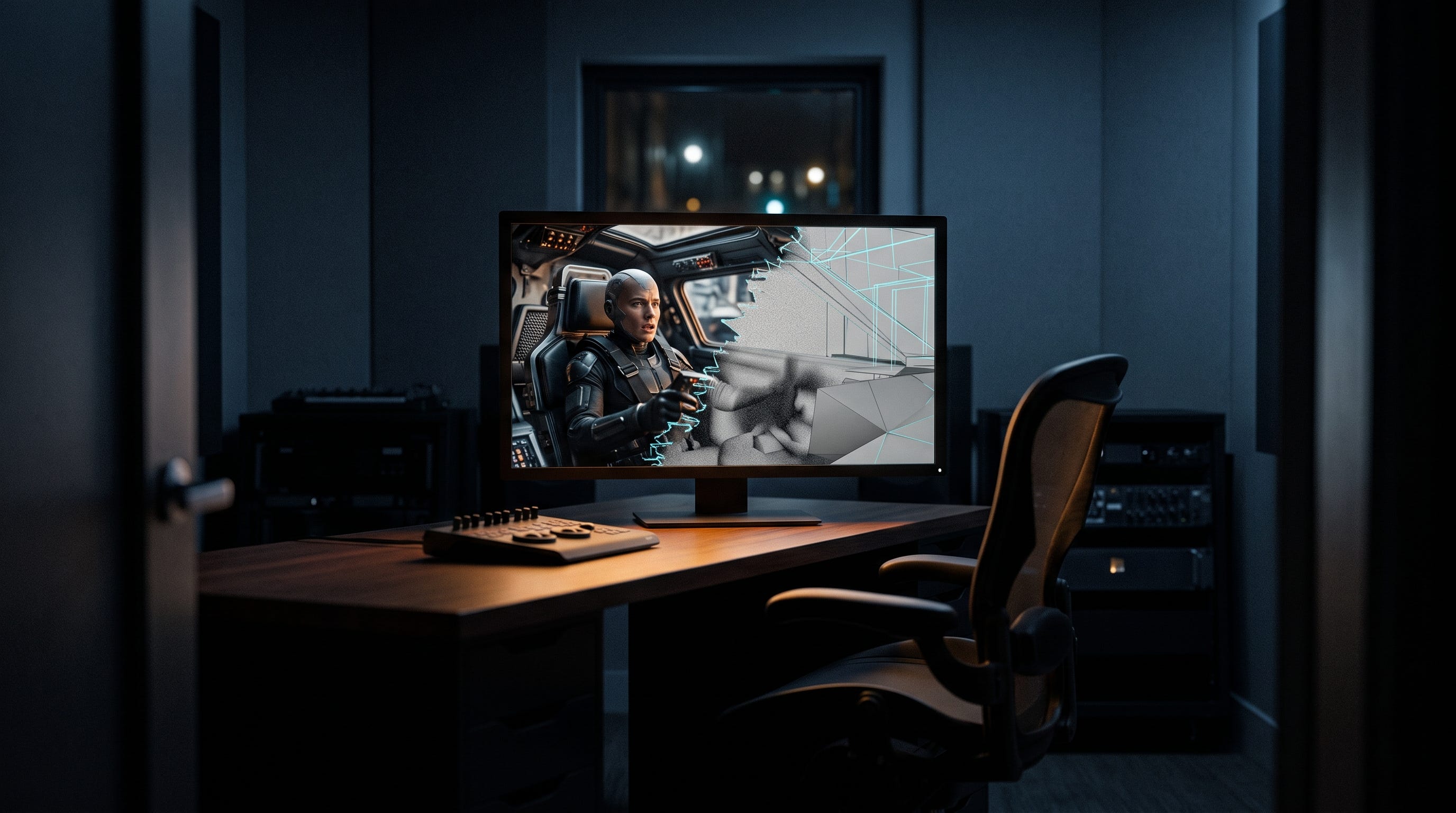
There is a joke at my company that I work in the applied science department. Meaning I do not build the technology. I spend my time thinking about what it does to industries. I was on the phone with a board member this morning about the movie business, and told him I was going to write this one down.
We’ll See It in the Morning
I’m told that sentence is the oldest working phrase in post-production. A shot goes out to the render farm at the end of the day and comes back finished at the start of work the next morning — hence overnight. Everything following is built to that flow. Dailies are called dailies because a day is the typical work unit. Notes get batched to the next run. A supervisor plans a week as five looks at five versions of the same twelve seconds.
The overnight is not a choice of scheduling. It is the time it takes to compute a picture.
One frame at feature quality is millions of pixels. For each one, the computer runs a line out from the camera into the scene and works out what that line hits first. Then it works out how much light is landing on that spot, by following the light back to every lamp and every surface that bounced some onto it. Disney’s renderer allows ten bounces before it stops. That is called ray tracing, and for a single pixel it is thousands of arithmetic steps, each step a transistor changing state, each state change paid for twice, once in the electric current going in and once in cooling the heat coming out.
Run that twenty-four times for every second of film and the entire night is what it takes to do the arithmetic. Let me say, to get it done in a night is amazing and it requires some brute machines.
Nobody Finishes a Movie
Wētā averaged around five hundred iterations per shot on Avatar: The Way of Water. A single frame took roughly eight thousand thread hours. A thread hour is one processor thread working for one hour, so that is a very large room of machines running flat out to produce one twenty-fourth of a second. I find that incredible.
The heaviest shot in the film consumed 13.6 million thread hours on its own. The five heaviest came to 51.6 million all combined.
Five hundred passes is not what a bunch of artists sat down to decide. No director sat in a review and concluded that this shot wanted five hundred and the one before it wanted four hundred and eighty. Five hundred is what was possible based on the schedule and the rate card. The director always wants more, but the delivery date arrives, and whatever was on the screen when the clock ran out is the version we see in the movie.
Every filmmaker I have spoken to confirms this and has made peace with it, the way outdoor catering makes peace with weather.
So Many Pictures Nobody Has Seen
The cost is decided long before anyone films anything. A visual effects budget gets assembled at script stage from a shot count and an estimate of complexity, and the number that comes back is large enough to reorganize the movie around it. The big studio pictures run twenty to forty percent of their budget on effects. Avatar has been put as high as sixty-three percent, and the 2019 Lion King at sixty-seven.
A number like that does not simply get paid. It gets managed, and it gets managed in the budget meeting, before a camera is even rented. What might have been a creature becomes a shadow. A crowd becomes twenty people shot from three angles. Weather that would have needed simulation becomes overcast. A sequence that three people in the room can already see gets cut in the same budget meeting, because there is no version of it that survives four hundred passes at forty thousand dollars a shot.
Everyone in that meeting knows exactly what they are doing. They are scaling the picture down to the machine hours they can pay for. The trade is invisible afterward, because the thing traded away never got made, so nobody misses it.
That is the part I keep coming back to. There are pictures nobody has seen because nobody could afford enough passes at them.
There’s a Reason We’re Doing Crypto and Rendering First
Rendering and mining are the same shape of problem.
To work out the color of one pixel, you don’t need the answer for any other pixel. Nothing waits on anything else, so all eight million of them in a 4K frame can be worked out at the same time, in any order, and the picture comes out identical. Mining is built the same way. A rig guesses a number, runs it through a fixed calculation, checks the result, and throws it away, and the next guess never needs the answer to the last one. You can run a billion of them side by side and never once run them in order.
That is the kind of work light is best at. Many calculations can travel down one path at the same time on different wavelengths, which transistor systems cannot do, and a switch made of light does not have to be charged up with current to give an answer back. Nothing has to be kept in order, so nothing has to wait for the other work.
The industry already uses light to move data between the computer racks. That part is called the interconnect. What has not gone to light is the logic element, the part that does the arithmetic, and rendering is the workload where light-logic pays first, because the frames can all be computed at once.
The Overnight Has Survived Every Speed-Up So Far
Twelve years ago Disney rendered Big Hero 6 on a fifty-five-thousand-core cluster spread across four sites, turning over roughly a million render hours a day. Last year Avatar: Fire and Ash required 1,248,087,308 render hours across 3,132 shots, which comes to about a hundred and forty-two thousand years of computing on a single processor.
Twelve years, and a machine that dwarfs the old one, and the overnight is still an overnight.
Every one of those gains came out of improvements in electron-logic and in the systems around it, arrived in increments, and was accomplished using more electricity and dissipating more heat. Each time the farm got faster the industry spent the difference on harder shots, because harder shots were what everyone wanted and the night was already built into the schedule. Nobody was trying to shorten the night. Everybody planned around it.
Think I’m Kidding About the Electricity
Wētā ran out of room in Wellington. The company outgrew the local power grid, and its executive visual effects producer has said that expanding the data center would have meant taking infrastructure to the city council. So they went to Amazon, and ran 3.3 billion thread hours in eight months.
The most expensive picture ever made was computed on somebody else’s machines because even a big studio could not get a permit.
Forty Passes in an Afternoon
Reduce nights to hours and the money saved is the least of it.
The bigger excitement is what a director might do with his fortieth look at a shot when he has spent his whole career deciding by the fourth. Nobody working today knows the answer, because nobody has ever worked with nearly unlimited looks. My guess is you’d get a picture somebody would have to be reckless to attempt right now.
The second thing that changes is who does the work. When passes are expensive you need a house large enough to carry a farm and absorb the risk of a price agreed to before the work starts, and the leverage in that relationship sits with whoever owns the machines. When passes are cheap and the machines are on the lot, a director and his crew run their own versions and can stop asking permission to try something. A crew of six attempts what a hundred people used to be needed for.
The Barbarians Are Waiting for Us to Open the Gate
Avatar: Fire and Ash took 1,248,087,308 render hours. Amazon’s cheapest published rate for film rendering is six tenths of a cent per processor-hour, which is the slow queue, the price you get for agreeing to wait. Multiply it out and the compute comes to about seven and a half million dollars.
That seven and a half million is a floor, not an actual bill. No big studio renders a delivery on the wait-and-save queue. The real figure is some multiple of that, and I didn’t try to source it. We can both imagine what it might be.
Divide the render hours by the 3,132 shots and each shot cost around four hundred thousand hours of computing. Wētā’s own average on the previous picture was five hundred passes a shot. Divide again and one look at one shot is roughly eight hundred hours of a machine changing the state of transistors.
A thousand times is the number I put in print about our coming photonic computer, and it belongs to the arithmetic rather than to the invoice. Eight hundred hours of machine time on a pass becomes something under an hour. The electricity cost behind those hours falls by the same order. What a studio pays is a separate question, because a price is set by whoever owns the machine and supplies the service.
We are not going to sell you a machine. For a good while we are not selling machines to anybody. What gets sold is the render, delivered, by a company that owns its own capacity and can run it on the power a building already has, with no substation, no cooling plant, and no water. That company carries a fraction of the overhead a render farm carries today, and it will price like it, because a supplier with that cost structure in a market this hungry gets to reprice everything.
The barbarians - my term here for small producers and creatives - have been outside this cost gate for thirty years, and it was never their scripts that kept them out. The scripts have been good enough the whole time. The lock on the gate has been the cost of the four hundred thousand hours of computing a shot. Move the price of that by three decimal places and the field stops having just a handful of players in it.
We all know I have an obvious interest here, so I will just state it plainly. We’ll build and host the machines, and industry partners hold the license to sell into their business. There won’t be many of those licenses. Whoever holds one becomes the company the rest of the business buys its renders from. Somebody is going to hold these seats. I would rather they were picture-makers than cloud companies.
Five hundred passes was what the budget allowed.
I’m already practicing my best Oprah for the day we turn this computer on.
You get to be done with overnights. You get to be done with overnights. And you in the back with the script nobody would finance and a cost wall that used to be too high, you get to be done with overnights.
Derek out.
Derek W. Bailey is the Founder of True Photonic, Inc. and author of Keep Computing: How Light Solves Computing’s Impossible Problem (2026). TPI is developing the Logic-in-Light™ architecture centered on the Poovey Switch, validated at 150–200 femtoseconds at the Technion Israel Institute of Technology.
Contact: dbailey@truephotonic.com
Disclosure: The author has a financial interest in the success of photonic computing technology. Performance projections are based on preliminary research, early-stage testing, and technical simulations. Actual results may vary.
Forward-Looking Statements: This article contains forward-looking statements regarding future technological capabilities and market developments. These statements involve risks and uncertainties that may cause actual results to differ materially. Readers should not place undue reliance on forward-looking statements, which speak only as of the publication date.