Larry Ellison Is Absolutely Right
And that's exactly the problem.

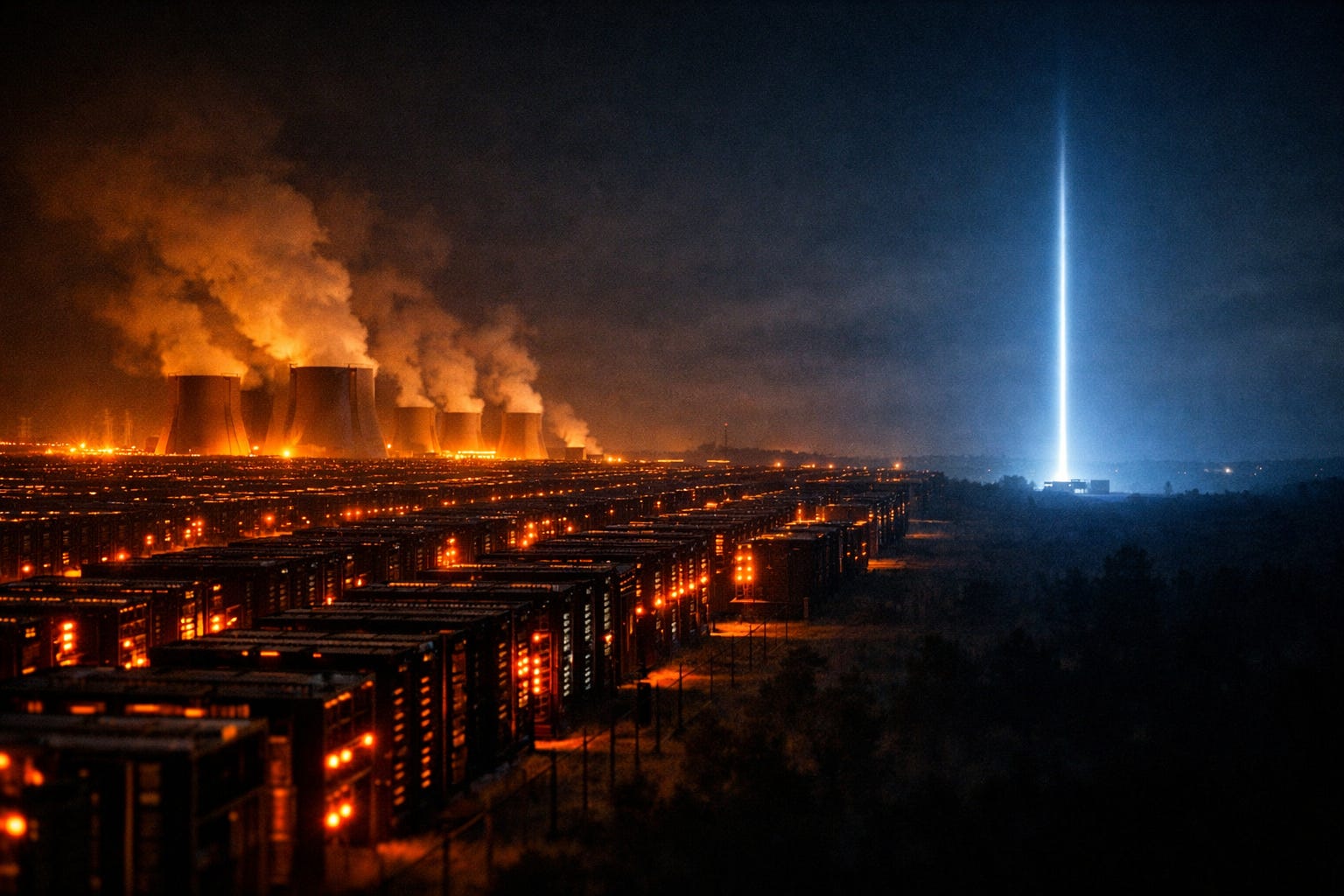
Larry Ellison sees the future of media clearly. Storage, protocol, distribution, content — own the stack, own the world. The thesis is correct, and the empire being built around it is genuinely impressive. But the physics all that sits on is last century. And the history of American technology shows that even the most brilliant empire cannot be protected from a patient startup with better physics.
This article is not an argument that Ellison is wrong, or that he will fail. This is my attempt to provide an observation about what the next infrastructure layer looks like — and what it means for the empire built on the one before it.
Let me be precise about what he has assembled. In the span of twelve months, the Ellison family has secured effective control of CBS, CNN, HBO, Warner Bros., Discovery, BET, Comedy Central, Nickelodeon, Paramount+, Pluto TV, Showtime, DC Studios, Miramax, and TikTok’s algorithm and data infrastructure — serving over 170 million Americans. The financial commitment backing all of this is $47 billion in guaranteed equity. Larry Ellison’s Oracle holds the cloud infrastructure on which TikTok’s algorithm runs. David Ellison sits atop the content. Larry holds the pipes. Together they have built something that no media family has assembled since the early days of broadcast television: a vertical stack from server room to living room.
The ambition deserves honest respect. Most people in technology acquire pieces. Ellison acquired the architecture. He didn’t buy a streaming service. He bought a theory about how the future of media works — and then built the infrastructure to prove it.
The thesis is right. The physics are wrong. And in technology, wrong physics is not a minor flaw. It is the flaw.
What follows is not an argument that Ellison will fail. It is an argument about what the next infrastructure layer looks like — and what happens to empires built on the previous one when it arrives.
I. The Stack He Bought
To understand the vulnerability, you first have to understand the strength. Oracle’s commercial empire was built on a single insight that Ellison has refined for fifty years: whoever owns the layer that everything else runs on top of wins. In the 1970s, that layer was the relational database. In the 2000s, it was enterprise software infrastructure. In the 2020s, it is cloud storage and data processing at planetary scale.
Streaming is, at its core, a storage and distribution problem. Content sits somewhere. It travels to you. The quality of your experience is determined by how fast it travels, how cheaply it is stored, and how much of it can move simultaneously across how many connections. Oracle’s data center investments — the ones currently requiring tens of thousands of layoffs to finance — are a bet that controlling the storage and distribution layer of the internet gives you durable structural advantage over everyone who needs to stream content to consumers.
That bet has a long track record of working. It worked in databases. It worked in enterprise software. It is working in cloud infrastructure today. The Ellison instinct — find the foundational layer, own it, price it, defend it — is not a guess. It is a proven playbook executed by one of the most successful technology strategists alive.
The problem with a proven playbook is that it proves the previous game. The game is changing.
The Ellison media empire is built on three assumptions that silicon physics makes necessary: that storage is expensive and centralized, that distribution requires high-cost infrastructure to manage spectrum scarcity, and that consumers must be bundled into subscriptions because processing small individual transactions costs more than those transactions are worth. Each of these assumptions is correct — on silicon. Each of them is about to stop being correct.
II. When the Road Itself Changes
The internet runs on TCP/IP. This is so foundational that most people who work in technology have stopped thinking of it as a choice. TCP/IP is the networking protocol designed in the 1970s for electronic networks with the physical characteristics of electronic signal propagation: packet loss rates, retransmission overhead, timing assumptions, and failure modes that are artifacts of the medium it was built for. Fifty years of engineering genius have optimized TCP/IP for the electronic world. Those optimizations are not achievements in a photonic world. They are constraints.
TCP/IP-L™ is a photonic networking protocol — a networking stack designed from the ground up for optical transmission: zero-loss photonic channels, femtosecond-scale switching latency, and the network topology that photonic infrastructure creates. It is not a faster version of TCP/IP. It is what you build when you no longer have to design around electronic physics. The retransmission overhead disappears because packet loss disappears. The buffering requirements collapse because switching latency drops below any threshold that requires compensation. The bandwidth assumptions built into every layer of TCP/IP’s architecture turn out to be artifacts of the medium, not requirements of the mathematics.
Oracle’s entire cloud empire — every data center, every storage array, every content delivery node — runs on TCP/IP. When the protocol layer changes at the physics level, the infrastructure built on the previous protocol does not become slower. It becomes a legacy system. Not immediately, not overnight — but with the same inevitability that every previous protocol transition has demonstrated.
Ellison didn’t buy the pipes. He bought the pipes that TCP/IP runs through. TCP/IP-L™ doesn’t need those pipes.
This is the competitive threat that does not appear in any analyst’s model of Oracle’s media strategy, because it requires understanding that the networking protocol — the road itself — is subject to disruption. The Ellison empire is buying toll roads. The question the article is raising is whether the next generation of vehicles requires roads at all.
III. Storage in Light, Spectrum in Abundance
Oracle’s second moat is storage. The company processes and stores data at a scale that creates genuine pricing power — not because storage is intellectually difficult, but because the infrastructure required to do it at Oracle’s scale takes years to build and billions to finance. Storage-in-Light™ — SIL™ — is a photonic memory architecture that operates at femtosecond speeds, integrates natively with photonic compute, and eliminates the optical-to-electrical conversion that defines Oracle’s infrastructure cost structure.
The economics are not incremental. When storage happens in light, the cost per bit stored collapses, the energy per retrieval collapses, and the latency per transaction drops to a range that makes Oracle’s current best performance look like magnetic tape compared to flash memory. The pricing power that comes from being the lowest-cost, highest-performance storage provider at scale requires being the most efficient storage technology at the physics level. SIL™ changes what the physics level looks like.
The third moat — and the one that receives the least attention — is spectrum. Conventional streaming burns bandwidth like a furnace, because silicon compute latency requires buffering, redundancy, error correction, and overhead that all consume spectrum that could otherwise carry content. The Ellison distribution empire is predicated on spectrum scarcity: TikTok’s algorithm is valuable partly because it efficiently allocates scarce distribution bandwidth. Femtosecond photonic compute eliminates the overhead that wastes spectrum.
A photonic network carrying content processed at 150 to 200 femtosecond switching speeds does not need the buffer overhead, retransmission allowance, or error-correction redundancy that silicon networks require. The same physical spectrum carries orders of magnitude more information. The scarcity that makes TikTok’s algorithm valuable — that makes any distribution bottleneck valuable — is partly an artifact of silicon physics. Remove silicon from the signal path, and the scarcity becomes significantly less scarce.
Oracle is buying distribution infrastructure priced on spectrum scarcity. Photonic compute makes spectrum dramatically more abundant. These two facts are on a collision course.
IV. The $0.05 Article and the End of the Bundle
Here is the most accessible version of the argument, the one that does not require understanding femtoseconds or networking protocols: you do not want to pay $15 a month for Paramount+. You want to watch three specific shows. You do not want to pay $16 a month for Max. You want to watch one specific film. You have been paying the bundle price for years not because you prefer it, but because the alternative — paying a few cents for exactly what you want, exactly when you want it — has never been economically viable.
The reason is not consumer preference. The reason is overhead. Processing a $0.05 transaction on silicon infrastructure — through credit card networks, payment processors, platform fee structures all designed for transactions with meaningful dollar values — costs more than the transaction is worth. The bundle is not a product that consumers chose. It is a workaround for a payment infrastructure constraint. Every subscription service in existence, from Paramount+ to the newspaper you pay $20 a month to read, is a bundle created because the alternative transaction size was economically irrational on the available infrastructure.
Photonic micro-payment rails, enabled by femtosecond-speed transaction verification, dissolve that floor. When the compute overhead of processing a transaction drops to near zero, the minimum viable transaction size follows. A reader pays $0.05 to read one article. A viewer pays $0.003 to watch one clip. A listener pays a fraction of a cent per song play — directly to the artist, with no platform intermediary required. A sports fan pays per minute of the game they actually want to watch, not per month of a package that includes seventeen channels they will never open.
The subscription bundle that funds the Ellison media empire is not a business model. It is a workaround for a payment infrastructure constraint. Remove the constraint, and the bundle has a structural problem.
I want to be careful here about the timeline. Photonic micro-payment infrastructure is arriving, not arrived. The transition will not happen overnight, and the bundle has genuine consumer inertia working in its favor. But the inertia is not infinite. When a credible alternative exists — when paying $0.05 for the article you actually want to read becomes a real option rather than a theoretical one — the bundle starts losing customers at the margin. In subscription economics, customers lost at the margin are rarely recovered. The Ellison empire is pricing its acquisitions on the assumption that the bundle survives. That assumption deserves scrutiny.
V. American Capitalism’s Best Trick
None of this is unprecedented. The pattern is so consistent across the history of American technology that it has the quality of a law rather than an observation.
AT&T built the most powerful telecommunications monopoly in American history. It did not lose to a better telephone company. It lost to a packet-switched network that made circuit switching — the foundational assumption of AT&T’s infrastructure — irrelevant. IBM dominated the mainframe era with a thoroughness that led the Justice Department to pursue one of the longest antitrust cases in American legal history. IBM did not lose to a better mainframe. It lost to the personal computer, which made the mainframe’s centralized architecture beside the point for an entire category of computing needs. Microsoft owned the desktop operating system with a lock that seemed unbreakable in the 1990s. Microsoft did not lose to a better desktop OS. It lost to the browser, and then to mobile, where its desktop dominance was simply irrelevant.
In each case, the monopolist was doing the right thing. AT&T was optimizing telephone infrastructure brilliantly. IBM was building the most powerful mainframes ever made. Microsoft was improving Windows with genuine engineering ambition. The disruption in each case did not come from a competitor who found a better way to play the existing game. It came from a competitor — or an entire ecosystem of competitors — who changed what the game was.
Ellison is doing the right thing. He is optimizing the current infrastructure layer — silicon compute, TCP/IP networking, centralized storage, subscription bundling — with the sophistication of someone who has spent fifty years learning how technology empires are built and defended. The empire he is assembling is, on its own terms, formidable.
The most dangerous competitor to any empire is never the one who fights on the empire’s terms. It is the one who makes the terms irrelevant.
The United States has, as a matter of economic history, been unusually good at producing the upstart that changes the terms. Not always from where incumbents expect. Not always on the timeline analysts project. But with a regularity that suggests something structural about how American markets work: new infrastructure layers do not ask permission from the empires built on previous ones. They simply arrive, and the empires adapt or decline.
Photonic computing — femtosecond switching, Storage-in-Light™, TCP/IP-L™, photonic micro-payment verification, the photonic mesh network that makes any surface a distribution node — is not a better version of what Oracle has built. It is the next infrastructure layer. The one that does not run on silicon physics, does not require TCP/IP’s electronic-era assumptions, does not need Oracle’s data centers to move content from server to screen, and does not need the subscription bundle as a workaround for transaction overhead that photonic rails eliminate.
The Light He Didn’t Price In
I want to be honest about where this stands. The photonic infrastructure that changes these equations is arriving, not arrived. The patents are filed, the physics are validated, the architecture is built — but deployment at the scale required to challenge what Oracle has assembled takes time, capital, and the kind of institutional patience that infrastructure transitions have always required.
What I can say with confidence is this: Larry Ellison has correctly identified that the future of media is an infrastructure play. He has correctly identified that owning the stack from storage to screen is the strategic position worth holding. He has acquired that position, at extraordinary cost, with impressive speed and precision. The thesis is right.
The infrastructure he has purchased runs on physics that photonic computing is in the process of making obsolete. Not the content — the content will always matter, and nothing about photonic computing changes what makes a great story. But the pipes that carry it, the protocol that governs how it travels, the storage systems that hold it, the transaction rails that determine how it is paid for — all of these are silicon-era solutions to problems that photonic infrastructure solves differently, at lower cost, at higher speed, with less spectrum, and without the centralized chokepoints that make Oracle’s position valuable.
Every great technology monopoly in American history has eventually encountered the upstart that found the better physics. The upstart rarely announces itself. It rarely fights on the incumbent’s terms. It rarely wins by being a better version of what the incumbent built.
It wins by making the question of who built the better version irrelevant.
That is what American capitalism was designed to do. And on the evidence of the last seventy years, it is very good at it.
We’re rebuilding his stack in light.
About the Author
Derek W. Bailey is the Founder of True Photonic, Inc. (TPI), a photonic computing company whose core invention — the Poovey Switch — has been independently validated at 150–200 femtoseconds switching speed, representing a minimum 10,000× improvement over silicon with approximately 90% energy reduction. TPI’s patent portfolio includes Storage-in-Light™ (SIL™), TCP/IP-L™, the Hash Engine, and photonic micro-payment verification architecture. He is the author of Keep Computing: How Light Solves Computing’s Impossible Problem (2026). He can be reached at dbailey@truephotonic.com.
Forward-Looking Statements & Disclosure
This article contains forward-looking statements based on the author’s current expectations and assumptions regarding photonic computing technology, market conditions, and competitive dynamics. These statements involve known and unknown risks and uncertainties that may cause actual results to differ materially from those expressed or implied. Forward-looking statements are not guarantees of future performance. True Photonic, Inc. makes no representation that the events, timelines, or outcomes described herein will occur as projected. Nothing in this article constitutes an offer to sell or a solicitation to buy any security. The author holds a financial interest in True Photonic, Inc. and related ventures. All technologies referenced — including Storage-in-Light™, TCP/IP-L™, and photonic micro-payment verification — are the subject of pending patent applications; no representations are made regarding grant, scope, or enforceability. All references to the Ellison family’s business activities are based on publicly reported information. Readers are encouraged to conduct their own due diligence.